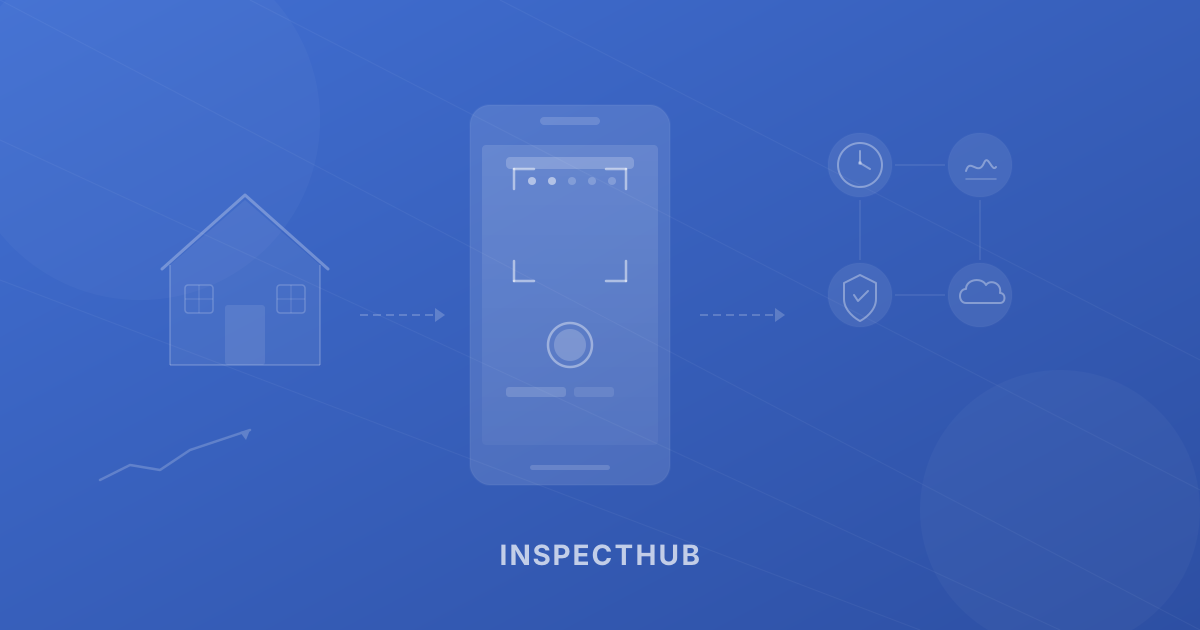
Property Inspection Apps in 2026: Why Landlords Are Going Digital
Something shifted in 2025. For years, "property inspection app" was a niche search term. A handful of landlords and property managers looking for digital alternatives to clipboards and phone cameras. Then, almost overnight, interest exploded. Search traffic grew over 550% in under a year. "Digital property inspection," a term that didn't exist in search data before mid-2025, appeared and grew to meaningful volume within months.
What happened? And why are landlords, hosts, and property managers across Europe and the US suddenly looking for digital inspection tools?
Why now: the forces behind the shift
Three converging pressures pushed property inspections from paper to digital.
Disputes got expensive. In the UK alone, the average rental deposit is now £1,175, and cleaning and damage claims account for over half of all formal disputes. Once legal costs, lost rental income, and personal time are factored in, even a straightforward dispute can cost landlords thousands. Landlords who'd been absorbing small losses for years hit a tipping point: the cumulative cost of poor documentation exceeded the cost of fixing the process.
Platforms stopped protecting hosts. In short-term rental communities, particularly Airbnb, hosts discovered that platform-provided protection often didn't function as advertised. Claims were denied despite documentation. Processes were slow and opaque. The community consensus hardened: the burden of proof is entirely on the host, and the host's own documentation is the only reliable protection. Phone photos, paper checklists, and memory weren't cutting it anymore.
Regulation tightened. Across the EU, data protection requirements (GDPR), new rental compliance rules, and evolving standards for digital evidence raised the bar for what constitutes a legally valid property condition record. A paper checklist signed with a pen is harder to verify, easier to alter, and less defensible than a digitally signed, timestamped photographic record. Landlords managing properties across borders needed tools that met the legal standards of multiple jurisdictions.
What property inspection apps actually do
At their core, property inspection apps digitize the move-in/move-out documentation process. Instead of walking through a property with a clipboard, the landlord (or tenant, depending on the app) uses a phone or tablet to photograph each room, note any issues, and generate a structured condition report.
But the range of what different apps offer varies enormously. At the basic end, some are little more than photo-organizing tools with templates. At the advanced end, they provide guided room-by-room capture with required angles, server-side timestamps, digital signatures, cloud storage, and legally formatted reports.
The key capabilities that separate useful tools from glorified camera rolls:
Guided capture. The app walks the user through each room with specific photo requirements. Not just "take a photo of the kitchen" but "photograph the countertop, the cabinet fronts, inside the oven, the sink and tap, the floor." In host communities, the most common documentation failure is missing rooms or surfaces. Guided capture eliminates that by making it impossible to skip steps.
Server-side timestamps. Not phone EXIF data (which is editable), but server-side timestamps that log when each photo was uploaded. In a dispute, the difference between "a photo that claims to be from March 22nd" and "a photo uploaded to a verified server at 14:32 on March 22nd" is the difference between an assertion and evidence.
Digital signatures. Both parties, landlord and tenant, sign the completed inspection digitally. This transforms a one-sided record into a mutually acknowledged document. An unsigned inspection is just one party's claim. A signed inspection is an agreed-upon fact.
E-signatures are legally binding across all EU member states under the eIDAS regulation and in the United States under the ESIGN Act. Not all apps implement e-signatures to the required standard, so check whether signatures are court-admissible, not just "digital."
Before-and-after comparison. The app stores move-in and move-out inspections side by side. When damage is disputed, the comparison is pulled up: here's what the kitchen looked like on move-in day, signed by both parties. Here's move-out day, signed by both parties. The damage is visible. Case closed.
Cloud storage. Every inspection, every photo, every signature stored securely and accessible for as long as needed. No more lost files or "I can't find the move-in report" emergencies when a dispute surfaces months later.
What to look for when choosing
If you're evaluating inspection apps (and search data says a lot of you are right now), here are the criteria that actually matter.
Legal validity of e-signatures. Does the app produce signatures that are legally binding in your jurisdiction? In the EU, look for eIDAS compliance. In the US, ESIGN Act recognition. Court-admissible is the standard. "Digital" alone isn't enough.
Timestamp verification. Server-side (verifiable by a third party) or client-side (EXIF data that can be edited)? Client-side timestamps are easily manipulated and may not hold up as evidence in a dispute. Server-side timestamps are far stronger because they're independently verifiable.
Guided vs. freeform capture. Can the tenant skip rooms or surfaces? If yes, the inspection will have gaps. Gaps are where disputes live. The best apps require completion of every section before the inspection can be signed.
Tenant experience. Does the tenant need to download an app? (Many won't.) Is the interface available in multiple languages? (Critical for international properties.) How long does it take? A faster, smoother tenant experience leads to higher and more timely inspection completion rates.
Storage and retrieval. How long are inspections stored? Can you access them years later? Is the data organized by property, date, and tenant? Can you export reports in standard formats for legal proceedings?
Template customization. A studio apartment needs different documentation than a 4-bedroom house. A furnished short-term rental needs different items than an unfurnished long-term lease. Make sure you can customize.
The self-service shift
The shift from landlord-conducted to tenant-conducted (self-service) inspections is changing how the entire process works.
The idea sounds counterintuitive. Why would you let the tenant document the property? Won't they hide damage?
In practice, the opposite happens. When tenants document the property themselves, they're more thorough, not less. The incentive structure explains why: the tenant knows these photos will be the official record. If they miss documenting a pre-existing scratch, they can't claim it was already there later. The documentation protects them too. So they photograph everything.
Property managers who've made the switch report catching significantly more issues through self-service inspections than through in-person walkthroughs. The explanation is straightforward: face-to-face inspections create social pressure where nobody wants to point out problems. Remove the face-to-face dynamic, and accuracy goes up.
The other advantage is timing. The tenant documents the property at the exact moment they hand back the keys, not a week before when you could coordinate schedules. The inspection and the handover happen at the same moment. No gap. No ambiguity.
For short-term rental hosts, self-service inspections are transformative. Guests document at check-in and check-out without the host being present. Each stay gets its own record, tied to that specific guest.
Self-service inspection tools like InspectHub let tenants complete the entire process in their phone browser. No app download, no scheduling. The landlord reviews and co-signs remotely.
For landlords and hosts evaluating tools now, the practical question is whether a digital inspection process would reduce the documentation gaps that lead to disputes. Given that cleaning and damage claims drive over half of all formal deposit disputes, and that most of those disputes hinge on the quality of evidence available, the case for better tooling is hard to ignore.
The growth in search interest suggests that more property owners are reaching the same conclusion: the manual approach has real costs, and digital alternatives are now mature enough to be worth adopting.
Key takeaways
- Property inspection apps grew 550% in search interest in under a year. The category is going mainstream in 2026.
- Three forces drive adoption: rising dispute costs, platform protection failures, and tightening regulation across the EU.
- Self-service inspections outperform landlord-led ones because removing social pressure makes both parties more thorough.
- The five non-negotiable features are: court-admissible e-signatures, server-side timestamps, guided room-by-room capture, cloud storage, and a frictionless tenant experience (no app download).
- Undocumented disputes lead to lost claims, absorbed damage costs, and unnecessary legal fees. These add up quickly, especially for landlords managing multiple properties or frequent turnovers.

The InspectHub Team
Insights from the team building the future of property inspections.
Related Posts
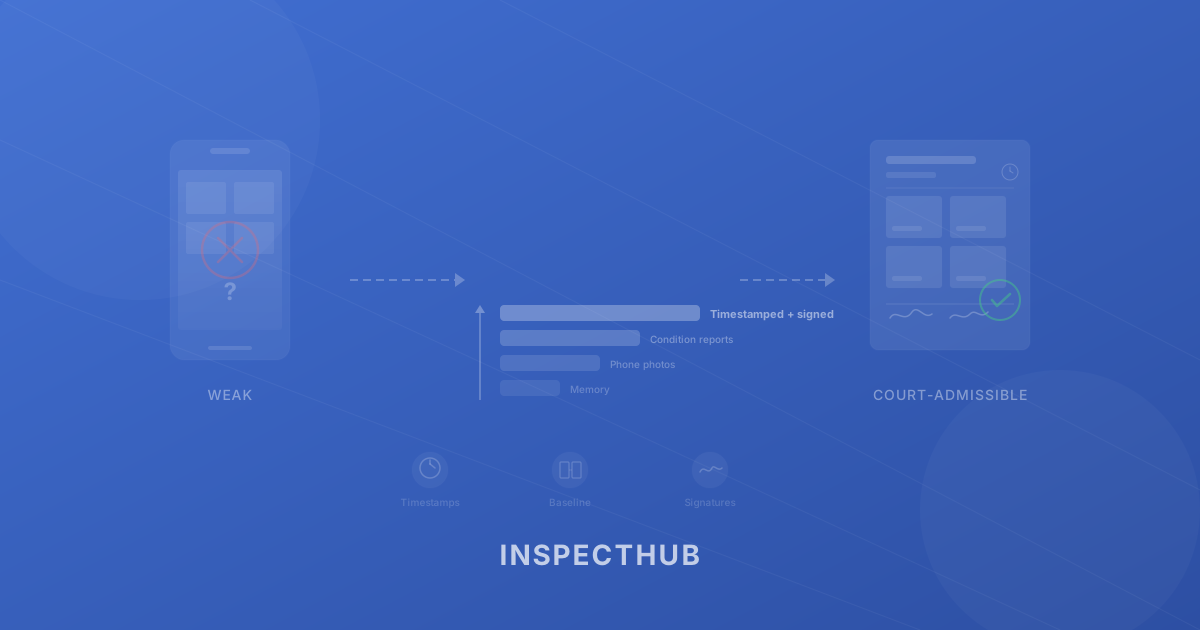
Before You Hire a Property Damage Lawyer, Read This
Every property damage lawyer asks the same question first: where's your evidence? Here's what actually holds up and how to build it.
Property Inspection Best Practices for 2026
A comprehensive guide to conducting efficient, thorough property inspections that protect both landlords and tenants.

The InspectHub Manifesto
Property management is broken. Landlords deserve profitability, tenants deserve quality, and the market deserves fairness. Here's our conviction.